
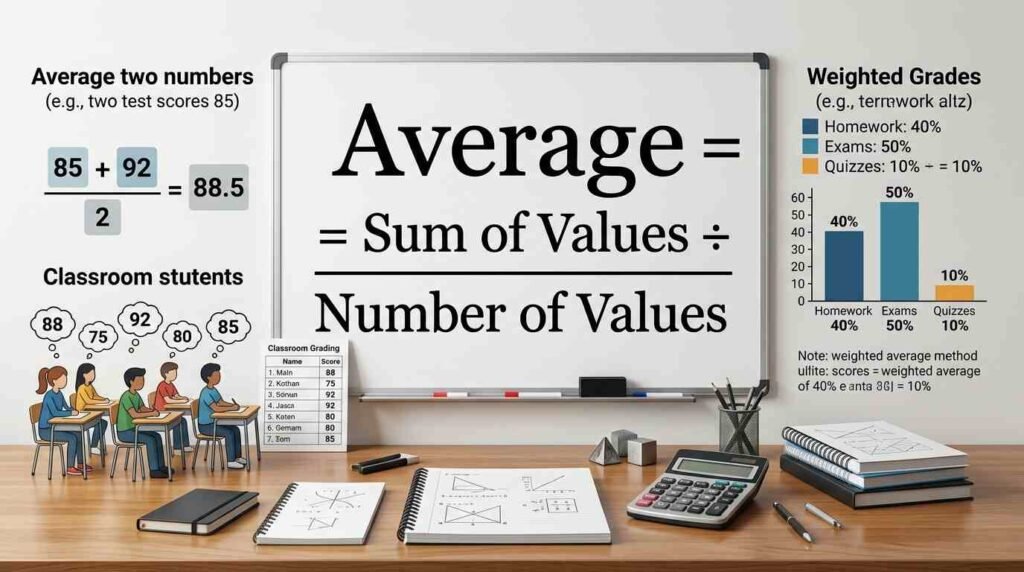
How to Calculate Average: Formula, Examples, Grades & Class Average
IIf you need to calculate an average, the basic formula is simple: [\boxed{\text{Average}=\frac{\text{Sum of all values}}{\text{Number of values}}}] For example,

IIf you need to calculate an average, the basic formula is simple: [\boxed{\text{Average}=\frac{\text{Sum of all values}}{\text{Number of values}}}] For example,
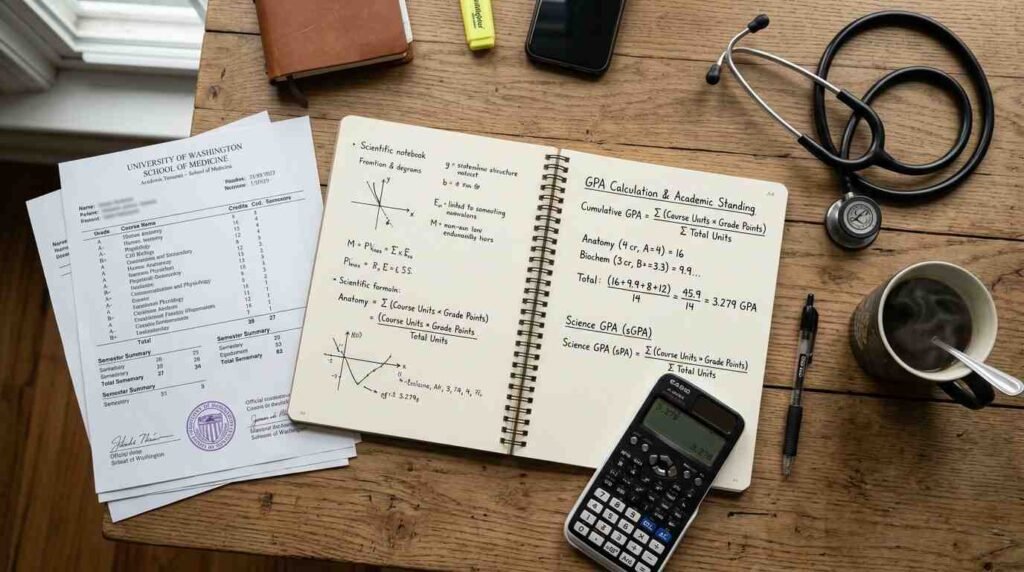
Your Science GPA is one of the single most influential academic metrics evaluated by medical (MD/DO), dental (DDS/DMD), physician assistant

Quick answer: Percentage Difference = |Number 1 − Number 2| ÷ ((Number 1 + Number 2) ÷ 2) × 100.

A bell curve doesn’t just “boost everyone’s grade” — it reshapes an entire class’s scores around the average, using statistics

Quick answer: If you’re currently enrolled, your GPA is usually visible in your school’s online student portal or on your

Quick answer: There are two different methods, and which one applies depends on your context. U.S. schools typically convert percentage

Quick answer: How much your final affects your grade depends on two things only — its weight, and how your

Quick answer: Multiply each grading category’s average by its weight (as a decimal), then add all the results together. Formula:

Quick answer: On the standard unweighted 4.0 scale, the highest GPA you can get is a 4.0 — straight A’s,

Quick answer: Convert each of your letter grades to points (A=4.0, B=3.0, C=2.0, D=1.0, F=0.0), multiply each by the class’s